MRI scans for ice hockey players – shoulder, wrist and knee injuries
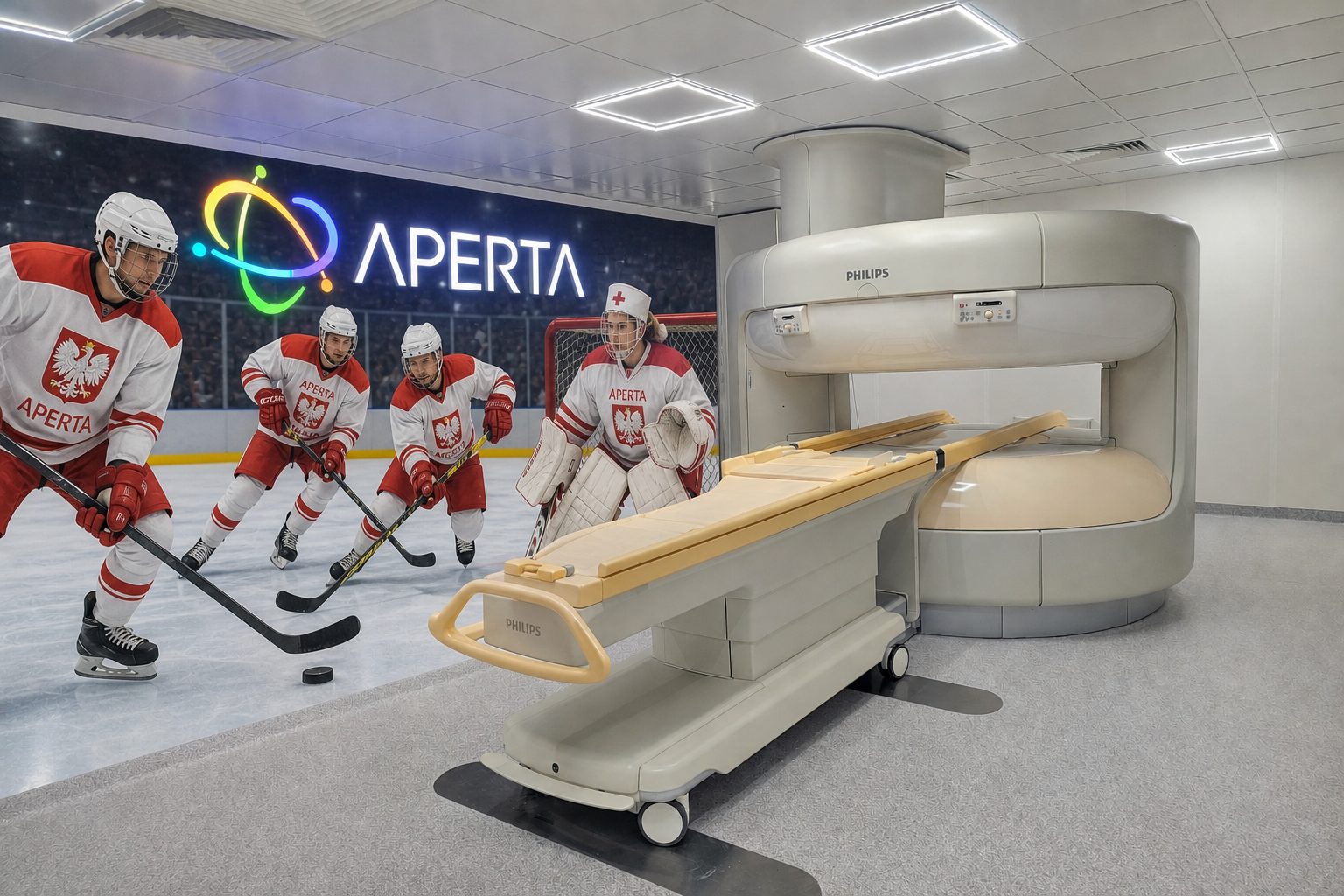
Hockey causes contact injuries (shoulder, collarbone) and overuse injuries (wrist, hip). The APERTA open MRI allows large-framed ice hockey players to be examined without any problems.
The most common conditions and recommended MRI examinations
The list below includes common conditions in ice hockey players and the recommended MRI protocols for diagnosis.
AC joint separation (acromioclavicular joint dislocation)
A classic hockey injury – a fall onto the shoulder. Rockwood classification I–VI.
Recommended MRI examinations:- Shoulder MRI focusing on the AC joint
- T2 fat-saturated axial and coronal
- Optional 3D sequences
Sports-related hip injury (FAI)
Femoroacetabular Impingement – a classic condition among ice hockey players.
Recommended MRI examinations:- MR arthrography of the hip joint
- T1 fat-saturated sequences with gadolinium
- Alpha angle measurement
UCL injury (hockey thumb)
Thumb injury following a fall onto the glove. A Stener lesion requires surgery.
Recommended MRI examinations:- Wrist MRI with a protocol dedicated to the thumb
- T2 fat-saturated in all planes
MCL injury of the knee
Valgus mechanism on impact. Often isolated grade II MCL.
Recommended MRI scans:- Standard knee MRI
- Coronal PD fat-saturated
Concussion
MRI following concussion in ice hockey players – to rule out structural injury.
Recommended MRI scans:- Brain MRI with DWI
- SWI for microbleeds
- FLAIR for axonal injury
Why is the 1T open MRI available for athletes?
- No width restrictions – bodybuilders, basketball players and hockey players of large build can be examined without any problems
- Comfortable position – the absence of a tunnel reduces post-injury stress
- Short scan time – most protocols take 15–25 minutes
- Specialist report – radiologist with experience in sports medicine
- MR-arthro option – intra-articular contrast for precise diagnosis
Are you a professional or amateur athlete?
Book an MRI scan without waiting in National Health Service queues. Results in 24–48 hours.
Book an MRI for athletes ->