
MRI with a pacemaker – safety
Do you have a pacemaker or an implantable cardioverter-defibrillator (ICD) and your doctor has recommended an MRI? Don’t worry – in 2026, over 90% of modern pacemakers are MRI-compatible (labelled as ‘MR-conditional’). This is a radical change compared to 10–15 years ago, when a pacemaker was an absolute contraindication for an MRI. I’ll explain how to check the safety of your device and what protocols apply at APERTA.
In this article
Classification of pacemakers: MR-conditional vs MR-unsafe
MR-conditional = safe under specific conditions (field strength, gradient intensity, monitoring). This applies to 90%+ of pacemakers implanted after 2010. MR-unsafe = MRI cannot be performed under any circumstances. Legacy/non-conditional = older devices; a decision must be made on a case-by-case basis with a cardiologist. Check: patient record, manufacturer’s information (Medtronic, Biotronik, Boston Scientific, Abbott), the MyHeart App, or consult an electrophysiologist.
MRI procedure with a pacemaker at APERTA
Standard protocol: 1) Consultation with a cardiologist prior to the scan (confirmation of MR-conditional status + consent); 2) Programming the device into MRI mode by a cardiac technician (usually immediately before the scan); 3) Monitoring during the MRI: continuous ECG, oximetry, voice contact with the technician; 4) Reprogramming after the MRI back to standard mode; 5) Post-MRI check – checking device function, adjusting parameters. The entire process takes approx. 90 minutes instead of the standard 30–45 minutes.
Field strength limitations (1T vs 1.5T vs 3T)
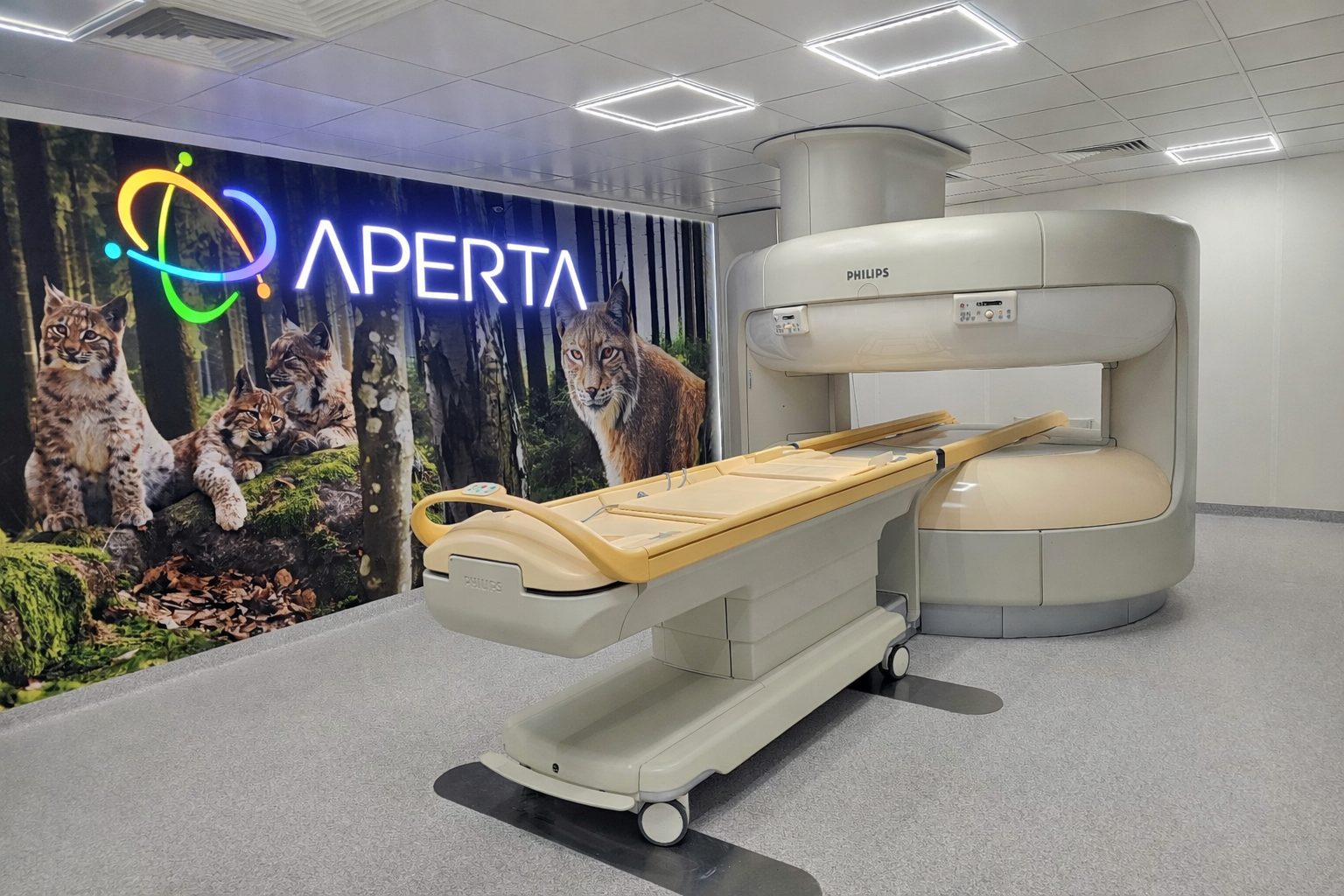
Most MR-conditional pacemakers are approved for fields up to 1.5 T. APERTA operates in a 1 T field, so this is within the safe range for the vast majority of devices. 3 T is more restrictive – only the latest models accept this. Some older pacemakers (pre-2008) are restricted to non-trunk examinations only (brain, limbs) – feasible, but not cardiac MRI or abdominal scans.
Other implanted devices
Cochlear implants: Most post-2014 models are MRI-compatible (Cochlear Nucleus Profile, MED-EL Synchrony). Older models require the magnet to be removed – consult your surgeon. Insulin pump: must be removed before an MRI (not MR-safe). Vascular stents: safe after 6 weeks. Artificial joints (TKA, THA): safe, imaging artefacts possible. Old surgical clips: may be problematic – check the material (titanium = OK, ferromagnetic = NO).
What to do if you don’t know what device you have
Step 1: call the electrophysiologist who performed the implantation (name on the patient’s chart). Step 2: if unavailable – contact the manufacturer (Medtronic +48 800 121 414, Biotronik +48 22 642 32 11, Boston Scientific +48 22 435 16 00). Step 3: APERTA has a consultant cardiologist who will help with identification and safety assessment. Please email the patient’s records before your appointment.
Frequently asked questions
Will an MRI damage my pacemaker?
With an MR-conditional device + protocol = virtually zero risk. With a non-conditional device = a real risk. Hence the need for consultation.
How much does an MRI with a pacemaker cost?
Approx. 50–100% more than a standard MRI (cardiologist + monitoring + longer duration).
Can I have an MRI more than once?
Yes, MR-conditional allows for multiple scans.
What if I have a pacemaker from 2005?
Check the documentation. Often NOT MR-safe – a cardiology consultation is required to discuss alternatives (CT with contrast).
Can a pacemaker affect the MRI image?
It may cause local artefacts. The overall diagnostic quality remains acceptable.
Can I stop the scan if I feel an unusual heartbeat?
Yes, always. We have a stop button and continuous ECG monitoring.
This content is for information purposes only and does not replace a medical consultation.